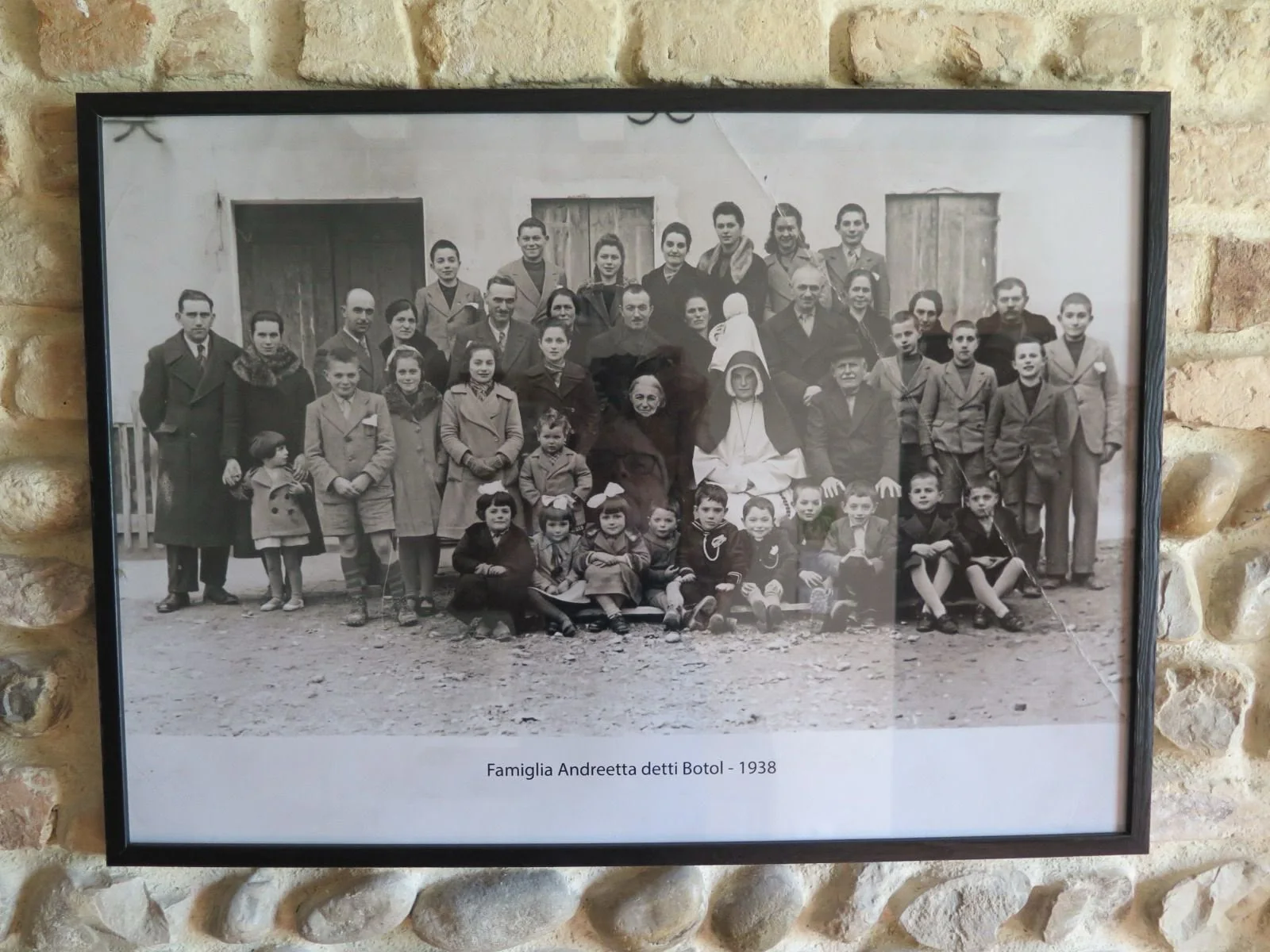
The Andreetta family, known as Botol, in 1938. Four married sons, their families and one great shared kitchen.
Family memories
At noon, the bell.
Told by Graziano Andreetta
My first memory of this house is the great kitchen, where we all ate together, unfailingly at noon, when the twelve o'clock bell rang.
Our fields produced many things. There was hay, because we had two cows that gave us milk, and we also made cheese from it. We grew maize to feed the animals, including the hens, and grapes from which we made our own wine.
We had a wine press, and many people came to our house to press their grapes because they did not own one. In payment, they left us several demijohns of wine.
When the maize cobs were harvested, they were packed into large sacks and carried upstairs to the attic, known in the local dialect as the granèr. They were spread out there to dry. It was exhausting work, usually done by my older brothers.
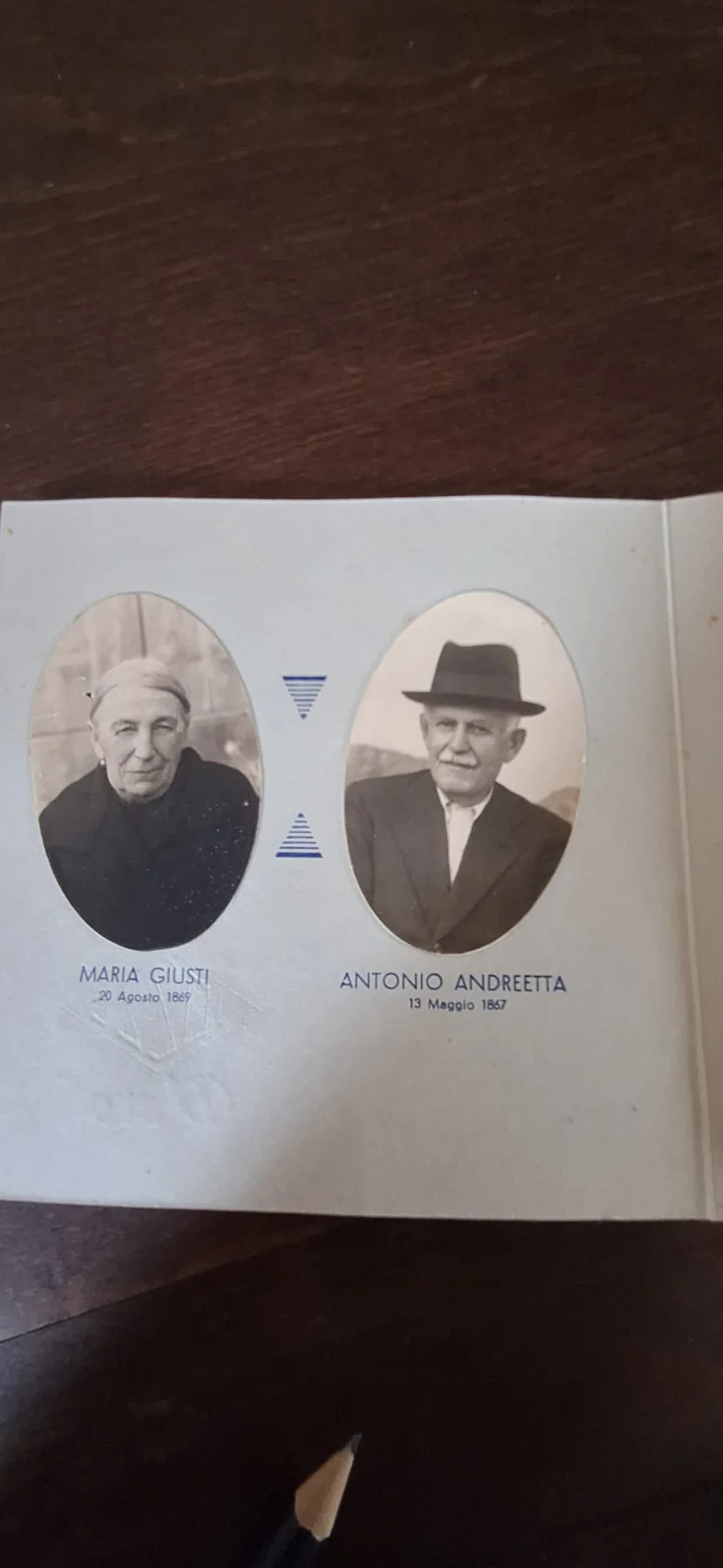
Maria Giusti and Antonio Andreetta. Graziano's memories reveal the private character of the family patriarch.
My grandfather
Head of the family.
Told by Graziano Andreetta
Although my grandfather was a very stern and austere man, he loved his large family deeply.
He took all his grandchildren to the seaside at Jesolo and had olive oil sent from Liguria in small wooden barrels. Every Sunday, he gave his sons their allowance.
Once, his sons, who worked as bricklayers, completed a job at a neighbour's house—the Feletto. The neighbour paid the sons directly rather than giving the money to my grandfather. He said nothing. The following Sunday, however, the customary allowance did not arrive.
“Let them spend the money they received for the work they did.”
He also served as a churchwarden of the parish of Gaiarine. In 1927, together with Giobatta Matiuzzi and Fortunato Carnelos, he requested permission to change the orientation of the church and enlarge it. The work was completed ten years later.
He travelled by horse-drawn carriage and went to nearby Roverbasso on Sundays to play cards. He said he preferred going there because the people of Gaiarine did not know how to play.
The Andreettas were a typical patriarchal family. Four married sons lived in the houses at numbers 13 and 15 with their wives and many children. Everyone shared a single kitchen, and Grandfather was the head of the family. Purchases in Gaiarine's shops were entered in the family account book; at the end of each month, he went around and settled the bills.
He died when I was five. My fondest memory of him is from nursery school. On his way towards the village square, he would pass beside the fence and hand me a white mint. To me, after all, he was not quite so gruff.
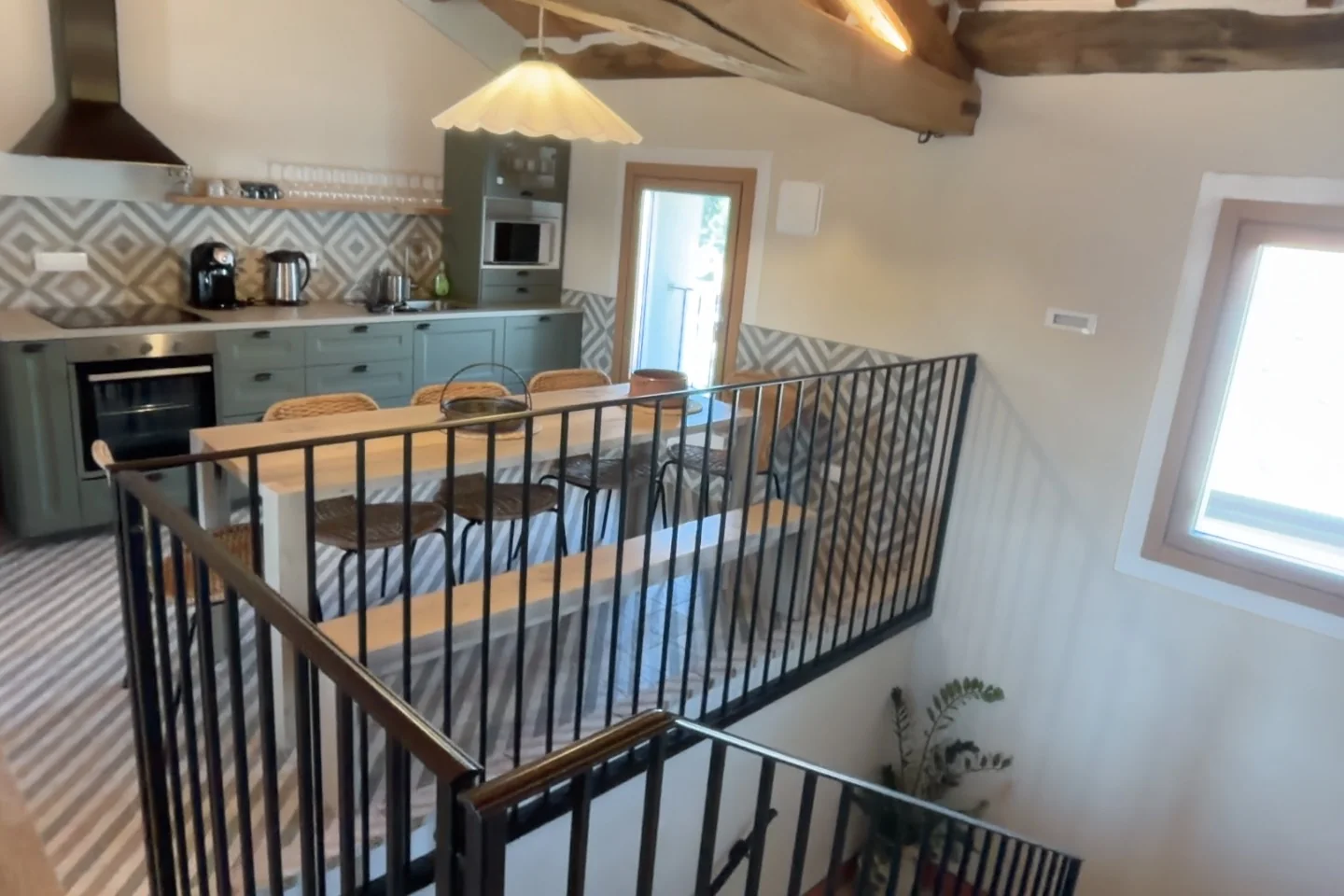
The shared kitchen today: a place to gather, cook and rediscover the pleasure of being together.
A house to share
A place that can breathe.
Told by Graziano Andreetta
I hope travellers remember above all the welcome they received, and that they never felt abandoned, but accompanied as they discovered the region.
The person who taught me most about cooking was my wife, Carla. I also learned through the many attempts I made when I travelled to Chile and lived in my small apartment. Today, the kitchen has once again become a gathering place.
We did not want to overload the rooms with too much furniture. We preferred to leave open space: even when a room is modest in size, the house should feel as though it can breathe. Double-glazed windows keep out outside noise and make it possible to find genuine silence.
The attic is the space that has changed most. It was once full of abandoned objects, with numerous bats flying through it. Today it has been completely transformed while retaining traces of its history.
During the restoration, I chose to keep the arch, the niche for the oil lamp, the well, the different types of masonry and the medieval fragments visible. I would like guests, as they look at the walls and objects, to enter the past and feel that the history of Borgo Botol is also the lived history of my family.
Attention to detail, cleanliness and hygiene are part of the same idea of respect. Borgo Botol is not intended as a place for hurried, passing tourism, but somewhere to rediscover the pleasure of sitting down, resting and feeling at ease.
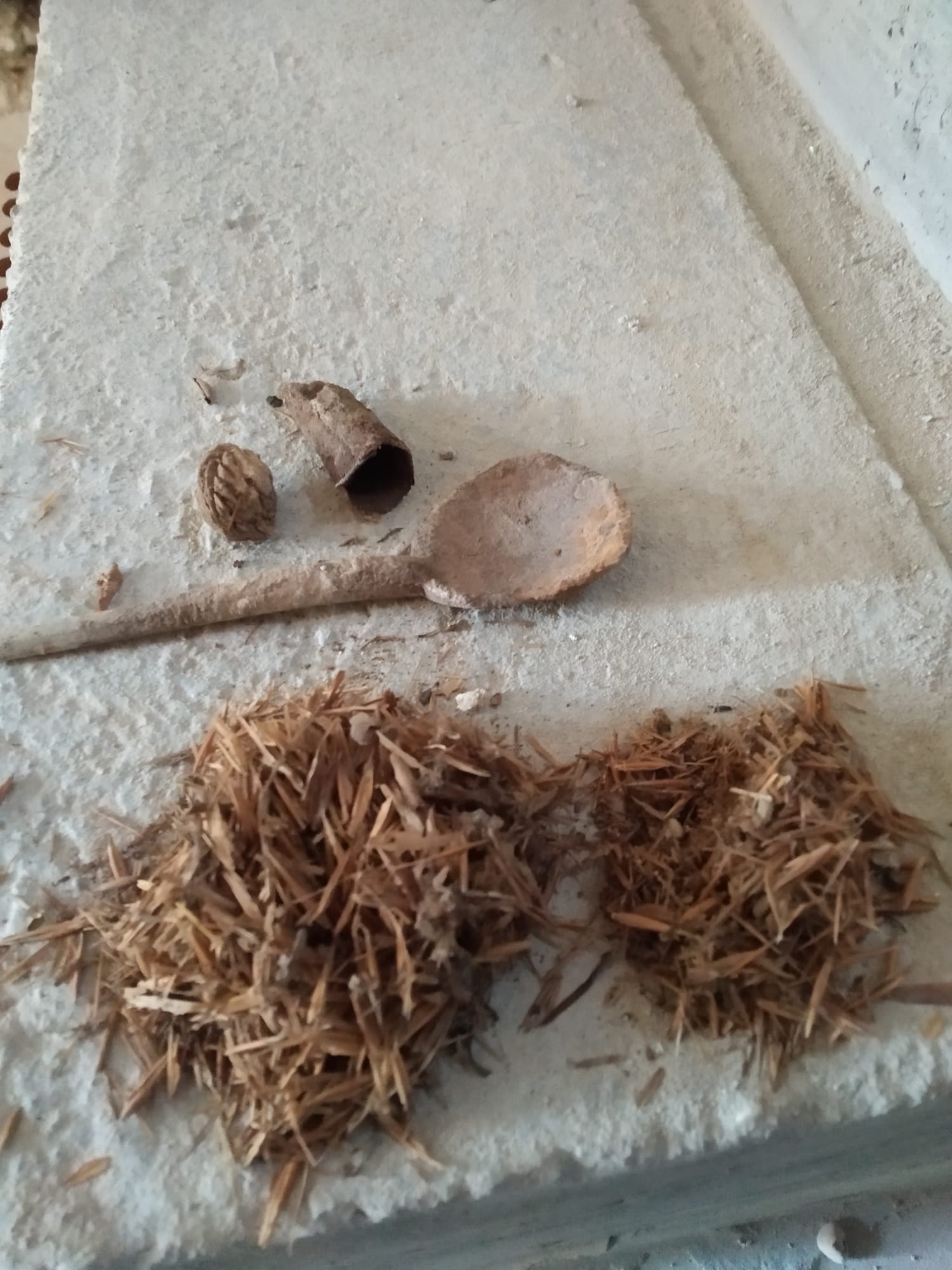
The objects as they emerged during the 2025 restoration: a wooden spoon, a peach pit, other seeds or shells and straw.
A discovery within the walls
The secret of the column
Deep inside the brickwork of a supporting column, the restoration revealed a small collection of ordinary things that had been hidden from view for centuries.
A worn wooden spoon lay beside a peach pit, other seeds or shells and bundles of straw. Their sealed position appears to connect them with an earlier rebuilding of the house, possibly the major restoration undertaken in the seventeenth century.
Across early-modern Europe, people sometimes placed everyday objects and natural materials inside the fabric of a building. Archaeologists describe these as concealed or special deposits. They could mark an important phase of construction, carry the memory of a household or express a hope that the house and the people living within it would prosper and remain protected.
Household, harvest and protection
The spoon evokes nourishment and domestic life. The peach pit and other seeds can suggest abundance, renewal and the promise of another harvest, while straw connects the house to the agricultural landscape around it. Sealing them within a load-bearing column may have placed those associations symbolically within the strength of the building itself.
No written record survives to explain the deposit, so its meaning cannot be proved. The objects might also reflect practical building activity or material gathered in an existing cavity. Their grouping and deeply enclosed location nevertheless make deliberate placement a compelling possibility.
Borgo Botol is not separate from the landscape around it.
The restoration, the apartments and these journeys all begin with the same idea: keep what is authentic, travel with curiosity and leave enough time to notice where you are.